
✔ Updated · Our 2026 picks
As an Amazon Associate, Recipe Fairy earns from qualifying purchases. This post contains affiliate links; we may earn a small commission at no extra cost to you.
Flaky biscuits come down to one thing: cold fat cut into flour fast, before your warm hands melt it. A good pastry blender does that in a minute, and I use one for every batch of our copycat biscuits.
For biscuits, the best pastry blender has stiff stainless steel blades rather than thin wires, because blades cut through cold, hard butter without bending. The OXO Good Grips is the best all-rounder. Choose a wire blender only if you mostly use shortening or softer fats.
- You bake biscuits or pie crust a few times a month: OXO Good Grips Dough Blender with Blades. Stiff blades, a padded grip and it goes in the dishwasher.
- You have big hands or make double batches: Spring Chef Dough Blender, Large. The wider head and longer handle cover a big bowl in fewer strokes.
- You grate or cube frozen butter: Gorilla Grip Pastry Dough Blender. The thickest blades here, so they do not flex on rock-hard fat.
- You mostly use shortening or lard: Mrs. Anderson's Baking 6-Wire Pastry Blender. Wires cut soft fat fast and this is the sturdiest wire style I would buy.
What is a pastry blender?
A pastry blender, also sold as a pastry cutter or dough blender, is a handle with a row of curved metal blades or wires underneath. You press it down through cold butter and flour, and it chops the fat into small pieces while coating each piece in flour. Those pieces are what bake into flaky layers in biscuits, scones and pie crust.
It does the same job as two knives or your fingertips, only faster and without warming the butter. If a recipe says to cut in the butter until the mix looks like coarse crumbs, this is the tool it is talking about.
What matters in a pastry blender for biscuits
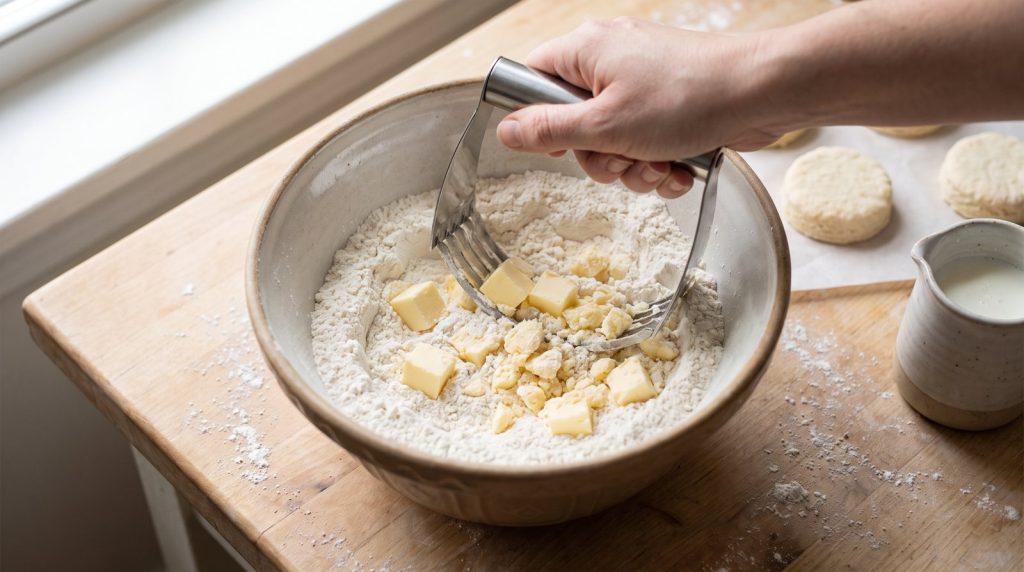
The goal is coarse crumbs with some pea-size bits of fat still visible. Those bits turn to steam in a hot oven and push the dough into flaky layers. A good blender gets you there quickly, so the fat stays cold. Here is what to look for:
- Blades or wires. Flat blades cut cold, hard butter cleanly. Thin wires suit shortening and softer fat, but can bend on cold butter.
- Stiffness. If the blades flex when you press, you end up smearing the butter. Thicker steel holds its shape.
- Handle and knuckle room. You rock and press for a couple of minutes. A padded handle with space for your fingers matters more than it sounds.
- Width. A wider head covers more of the bowl per stroke. Pair it with a wide, shallow bowl.
- Cleanup. Stainless blades with a plastic handle usually go in the dishwasher. Wood handles do not.
Pastry blenders compared
Specs come from the maker where it publishes them. Prices change often, so check the current price on Amazon.
| Model | Best for | Type | Count | Handle | Dishwasher |
|---|---|---|---|---|---|
| OXO Good Grips | Overall | Blades | 5 | Soft grip | Yes |
| Spring Chef Large | Big hands, big batches | Blades | Not published | Soft grip | Yes |
| Gorilla Grip | Frozen butter | Thick blades | 5 | Comfort grip | Yes |
| Mrs. Anderson’s | Shortening, wire style | Wires | 6 | Wood | No |
The 4 best pastry blenders for biscuits
1. OXO Good Grips Dough Blender with Blades
Best overall- Stainless steel blades, not wires
- 5 blades (per OXO)
- Soft, non-slip handle
- Dishwasher safe
Flat stainless blades cut through cold butter instead of squashing it, and the cushioned handle makes the rocking motion comfortable for the couple of minutes a batch takes. It is the shape most biscuit bakers end up with.
Like every bladed blender, butter can pack between the blades. Keep a butter knife nearby to scrape them clean as you go.
- Stiff blades handle cold butter
- Comfortable grip
- Dishwasher safe
- Butter can wedge between blades
- OXO's product page does not list the blade count; 5 comes from OXO's own blog
- Not the widest, so slower in a big bowl
Skip it if you bake in a wide 6 quart bowl every time; the head is on the narrow side and you will be rocking it for a while.
Check price on Amazon2. Spring Chef Dough Blender, Large
Best for big hands and big batches- Thick stainless steel blades
- Large size (Medium also sold)
- Soft-grip handle
- Dishwasher safe
The large size gives you a wider blade and more room for your knuckles, which helps if you have bigger hands or you are doubling a biscuit recipe in a wide bowl. Spring Chef says its blades are thicker than many others, and buyers mostly agree they stay straight.
Spring Chef sells several sizes and its own naming is a little muddled, so double-check you have the Large selected before you buy.
- Roomy handle and wide blades
- Popular, heavily reviewed
- Also comes in a Medium
- Size names can be confusing on the listing
- Can bend if forced through rock-hard butter
- Large is clumsy in a small bowl
Skip it if you have small hands or a small mixing bowl; the Large is clumsy in both, and Spring Chef sells a Medium for a reason.
Check price on Amazon3. Gorilla Grip Pastry Dough Blender
Best for frozen butter- 5 thick stainless steel blades
- Comfort grip handle
- Dishwasher safe
- Black or pink
Built around thick, sturdy blades, this one is aimed at people who cut in very cold or even frozen butter, which is exactly how I like to make biscuits on a warm day.
Gorilla Grip does not publish a spec sheet outside Amazon, so the details here come from the listing itself.
- Thick blades for very cold butter
- Dishwasher safe
- Comfortable handle
- Specs only on the Amazon listing
- No published dimensions or warranty
- Butter still packs between blades
Skip it if you want published specs and a named warranty; everything about this one comes from the Amazon listing.
Check price on Amazon4. Mrs. Anderson's Baking 6-Wire Pastry Blender
Best wire style- 6 stainless steel wires
- 18/8 stainless
- Wood handle
- Hand wash only
The classic wire shape. Thin wires are gentle and work well with shortening, lard or slightly softer butter, and it is the shape a lot of older biscuit recipes have in mind.
With fridge-hard butter, wires can bend and the butter tends to smear rather than cut. The wood handle means hand washing only.
- Light and gentle with shortening
- Classic, simple design
- Small and easy to store
- Wires can bend on cold butter
- Hand wash only, wood handle needs care
- Slower than blades with hard fat
Skip it if you work with butter straight from the fridge; the wires bend, and once they bend they smear rather than cut.
Check price on AmazonHow we chose
I keep a pastry blender in the baking drawer and use it for our biscuit and pie crust recipes, so the technique below is what I actually do. The specific models are another matter: we have not tested every one side by side, and we do not claim to. Each pick is based on:
- Verified specs: blades or wires, material and care, checked against the maker’s page where one exists.
- Documented features: blade thickness, handle design and sizes.
- Patterns in buyer reviews: recurring problems such as bending blades or butter clogging.
- Our own recipes: each pick has to cut cold butter or shortening into flour for our copycat biscuits and an all-butter pie crust.
How to cut butter into flour, step by step
This takes about two minutes, and the clock is the point: the faster you work, the colder the butter stays.
- Cube the butter into 1/2 inch pieces and chill it for 15 minutes in the fridge, or 10 in the freezer on a warm day.
- Whisk the flour, baking powder, salt and sugar in a wide, shallow bowl so the blender has room to move.
- Scatter the butter over the flour and toss with your fingers so every cube is coated.
- Press the blender straight down through the butter, give it a quarter twist, lift and move to the next spot. Rotate the bowl as you go.
- Scrape the blades with a butter knife whenever they clog, every 20 strokes or so.
- Stop when the mix looks like coarse crumbs with some pea-size pieces of butter still showing. Add the cold buttermilk straight away and stir only until it holds together.
The one mistake that ruins it: going too far. Sandy, even crumbs with no visible butter means no steam pockets, and the biscuits bake up flat and bready. Pea-size pieces are the goal, not a fault.
Here are the recipes I use mine for:

Bojangles Biscuits Copycat
Cold shortening cut into self-rising flour, then a hot 450°F oven for tall, fluffy layers.
Get the recipe →
KFC Biscuits Copycat
Fridge-cold butter cut in, a few kneads and a fold for flaky layers, baked at 415°F.
Get the recipe →
Carbquik Buttermilk Biscuits
Low-carb biscuits where very cold butter and cream do the flaky work.
Get the recipe →
Popeyes Biscuits Copycat
Buttermilk biscuits with cold butter cut in, a few letter folds and a hot 425°F oven.
Get the recipe →
Easy All-Butter Pie Crust
The same technique for pie: stop while you can still see pea-size bits of butter.
Get the recipe →
Red Lobster Cheddar Biscuits Copycat
Garlicky cheddar drop biscuits that start with cold fat cut into the dry mix.
Get the recipe →Care and cleaning
- Knock out the packed butter and flour with a butter knife before it hits the sink; it washes off far easier wet than dried.
- Plastic-handled stainless blenders like the OXO, Spring Chef and Gorilla Grip go in the dishwasher, top rack.
- Wood handles, like Mrs. Anderson’s, get a quick hot wash and a towel dry. Soaking swells the wood and loosens the wires.
- Dry between the blades before it goes in the drawer, or you get rust freckles where they meet the handle.
- If a wire bends, gently push it back with pliers. If a blade bends, it is time for a new blender; bent blades smear rather than cut.
Don’t have one? Use this instead
Ranked by how close they get to a blender’s result:
- A box grater. Grate frozen butter on the large holes and toss it through the flour. My favourite backup, and some days I prefer it.
- A food processor. 8 to 10 one-second pulses, no more. Fast, but it is easy to overdo and the bowl is a chore to wash.
- Two table knives. Cut across each other through the butter in a scissor motion. Slow, but it works and it keeps your hands off the fat.
- Your fingertips. Rub the butter into the flour quickly, using only the tips, and stop early. Fine in a cool kitchen, risky in a warm one.
Common biscuit mistakes
- Warm butter. Soft fat blends into the flour and bakes up flat and bready. Keep it cold until it hits the oven.
- Cutting it in too fine. Sandy crumbs with no visible fat mean no steam pockets and no flaky layers.
- Overmixing the dough. Stir in the liquid only until it comes together, or the biscuits turn tough.
- Twisting the cutter. When you stamp out the biscuits, press straight down. Twisting seals the edges and stops the rise.
- Using your fingers on a hot day. Warm hands melt butter fast, which is exactly why the blender helps.
Three recipes to make first
If the blender arrives this week, start here:
How we ranked these, and what we updated
Ranked on specs, features and what buyers report. Prices and availability checked October 2026. We do not claim to have tested every model side by side; where we have used a model in our kitchen, the card says so.
What we updated
- Added a 'which one is for you' box and numbered steps for cutting butter into flour, with the one mistake that flattens biscuits.
- Added a 'skip it if' line to every pick, care notes and three recipes to start with. The what-is and substitutes sections were already here.
- Prices and Amazon availability checked October 2026.
Frequently Asked Questions
Is a pastry cutter the same as a pastry blender?
Yes, in most American kitchens the two names mean the same hand tool: a handle with curved blades or wires for cutting fat into flour. Some bakers also call a flat bench scraper a pastry cutter, so check the photo when you shop.
Pastry blender or food processor for biscuits?
Both work. A food processor is faster but easy to overdo, since a couple of extra pulses can turn the butter to paste. A pastry blender gives you more control over the size of the butter pieces, and there is no machine to wash.
Can I use a fork instead of a pastry blender?
You can use a fork or two butter knives, or grate frozen butter on a box grater. They all work; they are just slower, and the longer it takes, the warmer the butter gets.
Why does butter get stuck in my pastry blender?
It happens to every bladed blender, especially once the butter starts to warm up. Scrape the blades with a butter knife every so often, and if it is sticking badly, chill the bowl for 10 minutes and carry on.
Should butter be frozen for biscuits?
Very cold is the goal. Fridge-cold cubes work well with a sturdy bladed blender, and on a warm day a short spell in the freezer helps. Rock-hard frozen sticks are easier to grate than to cut, and they can bend thin wire blenders.
Your turn. Which pastry blender is in your drawer, blades or wires? Tell me in the comments, and tell me if a pick here let you down. I read every one and update the guide.


